There’s not much going on. Danita’s enjoying the pool. I’m enjoying the bike. I saw an aggressive driver while I was riding the other day. You know — breaking hard, accelerating hard, switching lanes. That wouldn’t be all that unusual, except one of their rear tires was flat. It was making a heck of a racket. The rubber was flopping around. It look like it wouldn’t be long before large chunks of rubber would be flying off. I don’t see how the driver could not know that something was wrong. Fortunately, the driver went one way and I went another. I’ll never know what happened next.
We spent an evening at the Jones’, staying 6 feet apart.
I don’t know if I mentioned this, but I’m losing weight. I’ve been between 180 and 185 for the last 5 years. Almost exactly a month ago, for a reason I don’t understand, I weighed 179.8. It probably has something to do with not having neighborhood parties. That’s the first time in years that I was under 180. I took that as an opportunity to get back to my old weight of 169. According to some weight chart I found decades ago, that’s he highest weight that wasn’t considered obese. I’ve done pretty well. I’m down to 171. Just two more pounds to go.
We had some wonderful weather this week. It was not too humid, and temperatures were a little below average for August. Cold temperatures make my bike rides a short in the winter. Usually I start building up more endurance in the spring. This year when we got back from vacation everything was shutting down. That includes public toilets in libraries, senior centers, and even the spot-a-pots in county parks. That limits options. When parks opened back up, it was outrageously hot and humid. But I did what I could. My favorite endurance ride goes to Glenwood. It’s a beautiful 45 mile route that runs through Howard County farms and rural areas on excellent cycling roads. It’s largely an easy ride with a few moderate hills for a little zest. The sandwich shop at the terminus went out of business. Libraries and senior centers are still restricted. But the nearby county park is open. This week I did the Glenwood ride for the first time this year. It was fabulous.
A couple of days later I was doing my favorite hill ride. I was surprised to see a road was recently closed. Too bad, it’s a well shaded road that has a moderate grade to the top of the hill. I decided to take the alternate road up Ilchester Hill. This is the toughest paved hill in Howard County. Young men with too much testosterone hold time trials up the hill for bragging rights. Any one of them would drop me in a moment. But I made it up. It was a fun challenge.
The weeks are getting very quiet. We got Bud to the last of his doctor appointments. No more doctors for Bud for months! Hurrah! We went over to the Jones one evening. We’re both getting our exercise — me on the bike and Danita at the pool. Other than that, we’re staying in and staying un-infected.
Celebrations aren’t the same these days. Danita got herself takeout Chinese for lunch today. And something yummy from the bakery for after dinner tonight. She didn’t want a take-out dinner. She’ll be going over to the pool today to spend an hour checking that folks entering have their super-secret wrist band. Happy Birthday Danita.
I’m still playing around with computers in our clubhouse. Hopefully I’ll be done next weekend.
As most of you know, we have a deck in the back of the house, and a porch below the deck. In 2012 we turned our deck into a roof. When it rains, I can sit on the porch and supervise the rain. As part of the project, we put a super fancy floor on the deck so it never has to be painted again. Now the condo is repairing water damage to the houses. The question was, will they have to tear up the deck to repair water damage on our house, and if so who will pay for replacement? The engineer our condo contracted with visited our house this week. They won’t have to tear up the deck. That makes everything very easy. Our doors to the deck have water damage, so we will be replacing those. We had a choice of wood or fiberglass doors. We chose fiberglass. They’ll be plenty good enough for the time we’ll be in the house. Consumer Reports actually rated the Pella fiberglass as more waterproof than the wood. And they’re quite a bit cheaper. We could have had our doors “repaired” at no cost. But that would only ensure they don’t leak water. The damage to the door would still be there. And since we are spending no money traveling and precious little on birthday parties, we won’t have problems paying for new doors.
We were supposed to take Bud to the doctor Tuesday. During the tropical storm. It takes several minutes to transfer Bud between the wheel chair and the car. There is no under-cover parking at this doctor. The doctor was very kind and postponed the visit to next week with no penalty.
That’s it for this week. I hope this finds everybody doing well.
The driveway picnic last Sunday was great. Most of the neighbors came. We have shade in the driveway in the evenings. Everybody had a very good time. We have a gelato truck coming tonight. We’re looking forward to it.
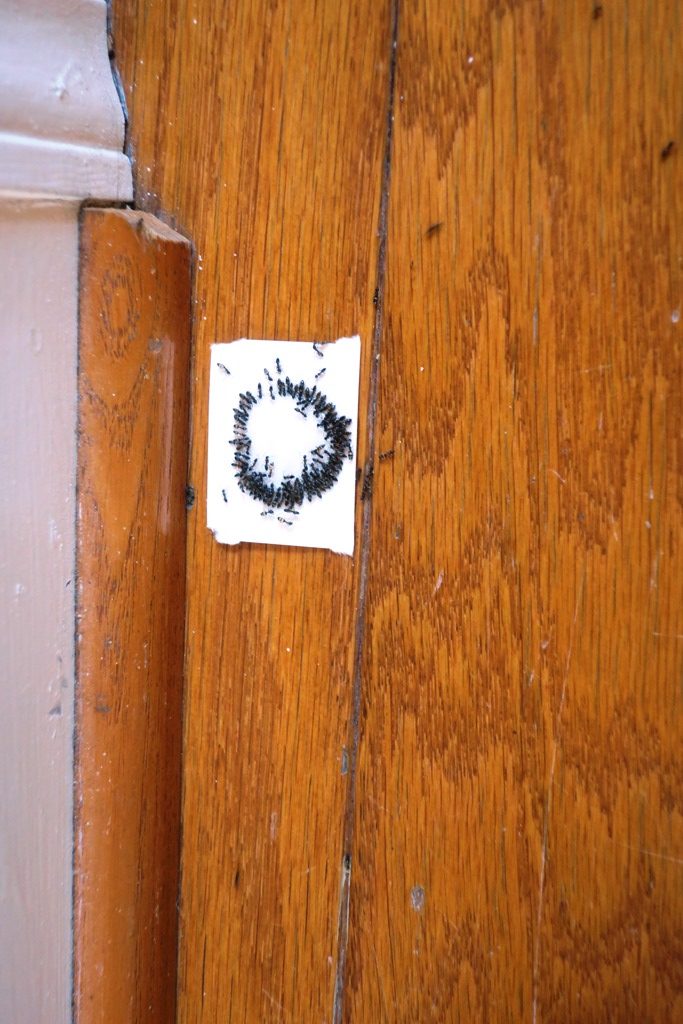
Last week, we got ants. They were on the stove top. They were in the pantry. They didn’t get into a lot of food, but they were a nuisance. We repackaged food and moved some of it to the refrigerator. We wiped up ants. And wiped some more. We got ant traps. Then we got “better” ant traps. In a few days, we were rid of the ants. Whew.
Danita made the best muffins. Chocolate toffee. We had them with split pea soup. They were so good, we were both a little piggy and had two. It’s a good thing, because when I got up the next day, there were thousands of ants all over the muffins. They weren’t in anything else. But they were all over the muffins. So we did more ant wiping. We ordered “better-est” ant traps. There were so many ants that I could finally see where they were coming into the house. This should be a big help when the better-est traps come in later on today. There’s no ants around today. But we’re not taking any chances. Everything is sealed or in the fridge.
Netgear is a company that makes network equipment such as routers. Somebody found that just about all Netgear routers have a serious security flaw. Netgear announced that our router is so old they aren’t going to release a fix. We have had several updates before this one. I understand that nothing can be support forever. But this router is only 3 1/2 years old. I think that’s a little harsh. There is open source software one can load on a router to give it new life. It’s called OpenWRT. Unfortunately, our Netgear router isn’t supported. So I purchased a new router. Made by TP-Link. I don’t know that TP-Link will be any better than Netgear. But I did make sure that OpenWRT will run on the new router. That doesn’t mean it will still be supported in 2023, but it’s a hope.
The rollout of the new computer for our office is going well. Our office manager found one glitch, which I was able to patch the same day. It’s not a permanent fix, but it’s fine for now. Yesterday I installed the software used to control the gate at the guardhouse. It seems to be fine. There were no complaints last night that I know of. I asked the office manager to issue a new card. I’ll make sure the new card works after the gate closes at 8 PM Monday. A vendor will be in this week to move software used to control the clubhouse doors. Next weekend, I should be able to re-configure the office manager’s old computer for our social coordinator. This project still has a way to go, but everything is moving smoothly. Smooth is more important than fast.
That’s it for this week. I hope everybody is doing well.
One of the office computers is old enough that we should retire it. After over 6 months of discussion, the board approved a new computer. I spent most of the weekend installing software and moving files. Hopefully, the day-to-day office functions are ready for use. We have two sets of security access cards. I’m holding off on changing those until we’re confident the computer is running well.
Danita and I took Bud to a dermatology appointment Wednesday. We’re down to just one more doctor appointment for Bud, in a couple of weeks. Woo-Hoo! Ed and Lynne dropped Addie and Suzanne at our house while they visited Bud Friday. We took the opportunity to set up a Zoom with Bryon and Elizabeth. All four kids seemed to enjoy it. B & E start school next week.
Mark and Jiajia visited yesterday. We had an excellent brunch and a very nice time talking. Plus we got to see their new car. It has plenty of room for a baby car seat. They were going to stop at Ikea on their way back home to look at baby furniture. Jiajia is in her new job as assistant dean. It didn’t take her long to learn what it’s like to work with faculty.
This evening we’re having the first neighborhood social function since the pandemic started. Two food trucks are visiting. We can’t all sit in the clubhouse like we used to do. Some people will sit on the porch. We have pool umbrellas set up in a couple of visitor parking areas. I’ve invited the people in our building to join us for a picnic in our driveway. All outdoors with proper social distancing, all providing our own everything (including chairs). Of course.
We had a socially distanced meal with Ed, Lynne, and their grand-girls this week. Ed and Lynne took Bud to one of his doctor appointments. They dropped Addie and Suzanne at our house. The girls largely entertained themselves. Danita prepared dinner wearing a mask, to make sure she didn’t accidentally infect the food. And I attended still another board meeting about the office computers. It was a good meeting. After about 6 months of discussion, the board approved a new computer. Then Ed & Lynne stopped on their way home and we had dinner together, socially distanced 6 feet apart, with two set of serving pieces.
Danita has personal good news this week. She took her last prednisone pill. She has some minor issues, which will hopefully slowly fade into history.
Thursday our neighbors came over. We sat on the back porch, 6 feet apart, with our own snacks and drinks, and had an evening of conversation.
WBAL TV is still not working. I re-arranged the TV antenna and found that we can record the DC station. That shows promise.
All in all, it was a good week. I hope this finds you doing well.
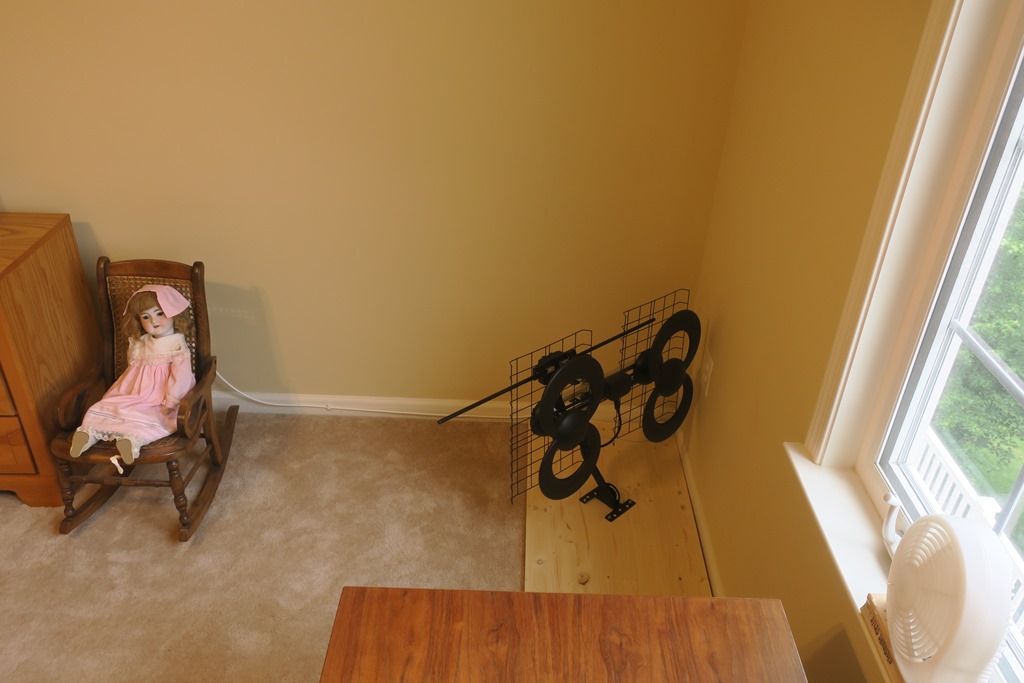
There’s big news this week. Huge news. Gargantuan. It’s the new TV antenna, and it is … well … big. The whole thing started when Danita couldn’t record some of her favorite shows. It turns out they were all on MeTV (channel 2.2), which is also the NBC network on channel 2.1. I looked, there was no signal for channel 2. I looked at the signal levels for other channels. They were all surprisingly marginal. I did a new channel scan. Still no signal. Obviously, our reception dropped below the threshold. I bought a new antenna. It’s meant to be mounted outdoors, but our HoA won’t allow that. I decided this antenna was large enough to find the signal if it was available. That would at least be a starting point to solve the problem. If the antenna was overkill, I could send it back.
The antenna did the trick. The Baltimore stations went from marginal to excellent, except PBS, which went to OK. And except for 11, which still had no signal. A few more channel scans later, there was finally enough signal that the TV recognized channel 11, but just barely. Sometimes we could see a picture, sometimes we couldn’t. I finally called WBAL. They said they had changed frequencies on July 1 and were having trouble with their antenna, so they were broadcasting on a backup antenna. They’re working day and night to get this fixed as soon as possible. So far, it’s been 11 days and 11 nights, and it ain’t fixed yet.
So why did WBAL TV have to change their broadcast frequency? Because mobile phones are more popular than broadcast TV. The FCC took away some of the TV bandwidth, sold it to cell phone companies, and started a “repacking” process to get all the existing TV stations to fit in the remaining channel space. The deadline for repacking was July 1. One Baltimore station apparently went out of business. Three DC stations are still working on switching to their new frequency. All of this happened during COVID. Advertising revenues are down. Weak stations sharing transmitters and working with old equipment are struggling the most. Nobody will be surprised to note that the stations having the toughest time serve minority or overtly religious communities. One would think there would be an outcry from minority communities. But I haven’t heard a single peep. Probably I’m listening to the wrong crowd, but still I’m amazed at how quiet all this is.
Anyway, our new antenna is in and apparently it’s going to stay. To give you an idea of the scale, the mounting board is 20″ x 36″. We could decide to move it into the attic, but I can’t fit my big old body into our cramped attic. If we decide to move the antenna, we’ll have to hire somebody.
Danita had a minor medical problem. She got quite a rash on her skin. She went to our medical practice emergency care. They aren’t taking appointments during COVID. It’s first come / first served. After signing in, going back to the car, and waiting 2 hours, she called to see how much longer the wait will be. They said there were 30 people in front of her. She came home and took an antihistamine. That gave a pretty dramatic improvement. Our working theory is that it was the sun block she wore to the pool.
That’s all for this week. I hope this finds everybody doing well.
This is getting tiresome. It has to be the quietest Independence Day since 1775. But we’re still staying the course. If we had any thoughts of loosening up, they were dispersed by Jul’s COVID scare.
The good news is we had another red letter day this week. Riderwood is allowing visits to residents in independent living. Danita and I went down to see Bud. Bud was in good spirits. Danita set up aids to visit Bud 2 hours a day 3 days a week. It was easy to see they have helped quite a bit. There was no spoiled food. The apartment was disorganized but clean. Pill compliance looked pretty good. We took Bud out for some blood work. Everything went smoothly. Friday Bud will have his first video doctor’s visit. Danita is bringing her computer. The Riderwood guest WiFi works very well. It should be interesting to see Bud’s reaction.
Our TV antenna has always been OK but marginal. This week, it went under the margin. I think it was a combination of very hot temperatures (mid-90s), very high humidity, and lots of rain this spring that brought lots of growth. The foliage and humidity are sucking up the signal. At lest that’s my story. I ordered a larger TV antenna. Let’s hope size matters.
We went to look at Anderson sliding doors this week. The doors were very nice, but the screen was not very good. The most important aspect of the deck doors to us is the screen, because that’s the only way to let fresh air in the house. So Anderson is scratched. Pella doesn’t have sliders in their showroom. (The receptionist actually tried to claim this was a COVID related issue.) This shouldn’t be that hard. If I could get away with it, I would put a wooden screen with a spring. You know the kind. You push the door open and walk through. The spring creaks as it stretches around the edge of the door. You release the door, and it bangs behind you. The best ones bounce a little and bang twice. The most important feature — a hook and eye to latch the door shut. Good times from the past.
That’s the news for this week. I hope everybody is doing well.
Someday, we might look back on these days as one of the greatest “Darwin filters” of modern times. The problem is, nobody knows for sure which behaviors are too risky. Danita and I are staying fairly conservative. But there are folks in our neighborhood that are more conservative than us. They never walk inside a store or restaurant. They wear masks when they exercise outdoors. Then there are those (mostly younger folk) who wear masks in stores (as required by Maryland), but don’t bother with any other precautions. And a surprising number don’t cover their noses. Are Danita and I being silly or risky? Nobody knows for sure. We’re just guessing as we go along.
Meanwhile, our neighborhood had a red letter day yesterday. We opened the pool. It’s for residents only. No visitors. No grand kids. All the community pool furniture has been stacked in a corner. Residents have to bring their own chair. They have to wear a mask until they are safely situated at least 6 feet apart. (No masks while in the pool, of course.) Residents have to sign a legal waiver, which they exchange for an ugly orange wrist band. All in all, the COVID rules are a page and a half long. (That doesn’t count the legal waiver or the regular rules, which are also in effect.) The maximum permitted in our pool at any time is 47. The board was worried that the pool would be too crowded because there’s nothing else to do. I never thought the pool would be crowded. Carrying your own chair down a long, steep ramp to the pool is something a lot of folks our age don’t find attractive. And truth be told, there always were a lot more people laying on a lounge chair than in the pool. 200 residents got orange wrist bands. Yesterday, a little over 30 people came. Danita is a big pool person and went over for some exercise yesterday and today. Both days, she has a lot of time where she was the only person in the water. I think it’s amazing how much gossip community news Danita picks up even when she sees only a couple of people she knows.
I spent a lot of time on our community computers. They wanted a new report with more information to use as a check-in list at the pool. That shouldn’t have been very hard, but somehow I ended up spending a day on it. We have a pool book with the pass numbers and photos of everybody who requested a pool pass. Our office manager had problems printing that out. This was hard because the cause of the error was obscure. That was another day of work.
We have one more piece of “big” news. Ever since we got back from our last trip, there have been items we wanted to buy but couldn’t find. The list kept on shifting. At different times, it was toilet paper, hamburger, hand soap, and so on. Thursday, I closed the list when I scored a 3-pack of active dry yeast. Woo-Hoo!
That’s a lot of excitement for one week. I hope this finds everybody doing well.